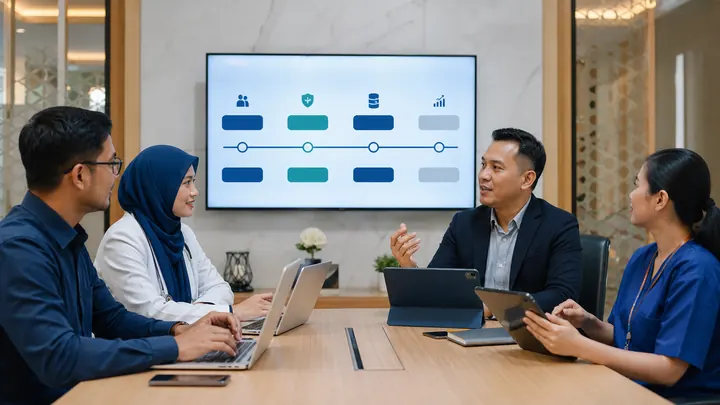
A hospital can have adequate servers, a fast network and a responsive IT team, and still stall when asked to meet every SATUSEHAT requirement. Another hospital, working with a far more modest technology budget, reaches full compliance first. The difference almost never lies in the hardware.
SATUSEHAT integration more often stops at something no architecture diagram shows: who is accountable for the quality of a given record, when that record is written, and how a decision is made when two units disagree about a single patient identity.
The integration challenge is not the system, it is the execution
The three obstacles below recur in hospitals whose integration stalls halfway.
- Systems that sit in isolation. LIS, RIS and EMR each run as their own island. Every island has its own format, its own owner and its own maintenance schedule, so a single small change has to be negotiated three times over.
- A double administrative burden on clinical staff. The same data is entered twice: once for internal purposes, and again so that it reaches SATUSEHAT. Extra work of that kind always loses to the queue of waiting patients.
- Data that falls out of sync. Laboratory and imaging results reach the medical record later than the patient reaches the clinic, and clinical decisions are delayed with them.

Integration is not merely a matter of connecting cables, but of aligning leadership and governance.
That reads like a slogan until someone tries to correct a single wrong data field and discovers that nobody is authorised to decide which value is right. Compliance that lasts requires a clear data owner for every source, not merely a connector with its light on.
Resilience comes from one ecosystem, not from patchwork
Connecting systems that already sit apart is always possible, but the cost does not end with the integration project. Every update to one system demands that all the connections attached to it be retested, and that retesting comes round every year.

- A fully paperless EMR as the single place where clinical events are recorded.
- MediPACS and MediRIS for a radiology workflow that is part of the medical record rather than sitting beside it.
- MediSyncLab for the laboratory, so that results become part of the patient file the moment they are issued.
- HRIS and quality management so that workforce performance and quality indicators are read from the same service data.
All of it surrounds SIMRS MediCare as the core. Once patient identity, scheduling and procedure history have a single source, submission to SATUSEHAT stops being an integration project and becomes an ordinary consequence of delivering care.
Transformation without the burden

What management fears most is rarely the cost; it is disruption to services during the transition. That concern is reasonable and it can be managed: what has to be settled up front is the rollout order unit by unit, the fallback plan should one stage go wrong, and who will stand beside clinical staff during the first few weeks.
With those three in place, staff are not asked to do anything new. They do the same work on a system that already submits its own data.
Congratulations to every MediCare partner

Our appreciation goes to every partner hospital that has achieved 100% SATUSEHAT compliance. That result did not come from installing a piece of software; it came from the right technology working alongside management willing to change how the work is done.
- Automatic. Submission to SATUSEHAT runs as a system process, not as an extra task somebody has to remember every day.
- Sustained. Data stays synchronised close to real time, so hospital quality indicators reflect today's position rather than last month's summary.
Key takeaways
Assign a data owner for every source before a single connector is installed, because compliance that lasts rests on governance. Choose one ecosystem over a chain of links between different systems, since what decides the outcome is the cost of maintaining it, not the cost of installing it. Measure success by how much data is submitted without manual intervention, not by how many modules are switched on.
Ready to transform without the drama?

If your hospital is preparing or repairing its SATUSEHAT integration, we can review the state of your systems today and show you which step is most realistic to take first.